POLITICS OF INTERNMENT 1971 #ReleaseMartinCorey Seelink http:... on Twitpic:
'via Blog this'
Showing posts with label John McGuffin. Show all posts
Sunday, August 11, 2013
Tuesday, May 1, 2012
Anarchy Love on May Day
Anarchists are often presented as being combative and anti-social, while their doctrine is co-operation and sociability. Peter Kropotkin explained the split between Anarchism and Marxism of the 1870′s in terms of cultural differences between Northern Europe and Southern Europe. France, Italy and Spain were the strongest centres of Anarchism while Marxist intellectuals were strongest in England, Holland and Germany. Ireland would identify more strongly with southern Europe for several reasons one of them being a sense of passion from the heart or E.Q rather than I.Q.
The Anarchist-Marxist split runs along the lines of Anarchism essentially being the concept of most people naturally wanting to be good to others when the incentives in the current system, that encourages people to be arseholes are removed, then tradition, custom and the natural desire to be good to family, friends and neighbours will regulate society. Marxism on the other hand believes, people need to be controlled by a dictatorship of the proletariat, without which Marxists cannot visualize a society functioning or maintaining cohesion.
Anarchists could perhaps do things smarter by attraction rather than promotion. Anarchism is mostly seen in terms of smashing the state, class warfare, propaganda of deed or as Bakunin said, “The passion for destruction is a creative passion.” However this is at odds with our greatest strength, which is our community focus, instead of smashing the state, perhaps we could consider building stronger communities, which no longer need the state and that we do propaganda of deed by actually building these communities?
Related Link: http://struggle.ws/rbr/rbr4_racism.html
Good men must die, but death cannot kill their names. - Proverb
The Late John McGuffin
The obituary cliche that "He didn't suffer fools gladly" was never more apt than for John McGuffin, which occasionally presented him with problems of an inter-personal nature, since McGuffin tended to regard a remarkably wide section of the earth's population as fools. Anybody who voted in an election ("It's wrong to choose your masters!"). All who had ever darkened the door of a church after reaching the age of reason. People opposed to cannabis. And that was just for starters.
One day in the late 1960s, when we thought we'd heard the chimes of freedom flashing, I drove to Dublin with McGuffin and the American anarchist Jerry Rubin. A mile or so out of Newry, McGuffin explained to the fabled member of the Chicago Seven that the town we were approaching was in the grip of revolution. The risen people had turned en masse to anarchism. We'd better barrel on through. If we stopped for a moment the fevered proletariat would surely engulf us...
Down were in the All-Ireland final that weekend. Every house, lamppost and telegraph pole was festooned with red-and-black flags. Rubin was agog, at risk of levitation when we passed under banners strung across the streets, reading, "Up Down!"
"These people really got the revolutionary ethic", enthused the ecstatic Rubin.
"As much as yourself, comrade", allowed the gracious McGuffin.
He turned up on the Burntollet march with an anarchist banner but couldn't persuade anybody to carry the other pole. He marched all the way with the furled standard sloped on his shoulder, managing to convey that this was sure evidence of his singular revolutionary rectitude, the easy-oozy reformism of the rest of us.
McGuffin was interned in August 1971, as far as I know the only Protestant lifted in the initial swoop. He wrote a fine book on internment afterwards, "The Guineapigs". He was later to publish "In Praise of Poteen", "The Hairs of the Dog" and, recently, "Last Orders, Please!". He was a gifted, utterly undisciplined writer, eschewing the pedantries of structure and all strictures of taste. Various newspapers agreed to give him regular space, but it never lasted. Editors physically winced at his ferocious philippics. He said to me of this column a few months back, "If it's any good, why havn't they sacked you?"
For a time, An Phoblacht published his scabrously brilliant "Brigadier" column. Frequently, the Provos wouldn't print it because they thought their readers would find it offensive. They weren't bad judges.
I first became aware of McGuffin within a week of arriving at Queen's as a wide-eyed innocent from the Bogside. He erupted into a debate addressed by Sam Thompson, the former shipyard worker whose play, "Over The Bridge", had convulsed the Unionist establishment with rage. Thompson was the hero of the hour for Northern liberals. But not for McGuffin. The only achievement of "Over The Bridge", he raged, had been to enable a section of the useless middle class to feel good about themselves for having a night out at the theatre. "Meanwhile, Basil Brook is roaming the streets..."
He took off for California in the early '80s, where he practiced as a lawyer for 15 years, advertising his services under the slogan, "Sean McGuffin, Attorney at Law, Irish-friendly - No crime too big, no crime too small". He only did defences and preferred getting people off who he reckoned were guilty because that way it was more fun.
He was my friend for 40 years. The announcement of his end told that he died peacefully on the morning of April 28th after a long illness, and that two days before turning sideways to the sun had married his long-term collaborator, comrade and partner Christiane.
He was laid out in his coffin with a smile of final satisfaction on a face sculpted like a chieftain of old, in a black t-shirt with square red lettering, "Unrepentant Fenian Bastard".
Way to go, McGuffin.
One day in the late 1960s, when we thought we'd heard the chimes of freedom flashing, I drove to Dublin with McGuffin and the American anarchist Jerry Rubin. A mile or so out of Newry, McGuffin explained to the fabled member of the Chicago Seven that the town we were approaching was in the grip of revolution. The risen people had turned en masse to anarchism. We'd better barrel on through. If we stopped for a moment the fevered proletariat would surely engulf us...
Down were in the All-Ireland final that weekend. Every house, lamppost and telegraph pole was festooned with red-and-black flags. Rubin was agog, at risk of levitation when we passed under banners strung across the streets, reading, "Up Down!"
"These people really got the revolutionary ethic", enthused the ecstatic Rubin.
"As much as yourself, comrade", allowed the gracious McGuffin.
He turned up on the Burntollet march with an anarchist banner but couldn't persuade anybody to carry the other pole. He marched all the way with the furled standard sloped on his shoulder, managing to convey that this was sure evidence of his singular revolutionary rectitude, the easy-oozy reformism of the rest of us.
McGuffin was interned in August 1971, as far as I know the only Protestant lifted in the initial swoop. He wrote a fine book on internment afterwards, "The Guineapigs". He was later to publish "In Praise of Poteen", "The Hairs of the Dog" and, recently, "Last Orders, Please!". He was a gifted, utterly undisciplined writer, eschewing the pedantries of structure and all strictures of taste. Various newspapers agreed to give him regular space, but it never lasted. Editors physically winced at his ferocious philippics. He said to me of this column a few months back, "If it's any good, why havn't they sacked you?"
For a time, An Phoblacht published his scabrously brilliant "Brigadier" column. Frequently, the Provos wouldn't print it because they thought their readers would find it offensive. They weren't bad judges.
I first became aware of McGuffin within a week of arriving at Queen's as a wide-eyed innocent from the Bogside. He erupted into a debate addressed by Sam Thompson, the former shipyard worker whose play, "Over The Bridge", had convulsed the Unionist establishment with rage. Thompson was the hero of the hour for Northern liberals. But not for McGuffin. The only achievement of "Over The Bridge", he raged, had been to enable a section of the useless middle class to feel good about themselves for having a night out at the theatre. "Meanwhile, Basil Brook is roaming the streets..."
He took off for California in the early '80s, where he practiced as a lawyer for 15 years, advertising his services under the slogan, "Sean McGuffin, Attorney at Law, Irish-friendly - No crime too big, no crime too small". He only did defences and preferred getting people off who he reckoned were guilty because that way it was more fun.
He was my friend for 40 years. The announcement of his end told that he died peacefully on the morning of April 28th after a long illness, and that two days before turning sideways to the sun had married his long-term collaborator, comrade and partner Christiane.
He was laid out in his coffin with a smile of final satisfaction on a face sculpted like a chieftain of old, in a black t-shirt with square red lettering, "Unrepentant Fenian Bastard".
Way to go, McGuffin.
Eamonn McCann
Tuesday, April 17, 2012
Peace Process Without Due Process
John McGuffin an Ulster Anarchist
John McGuffin an Ulster anarchist was cremated 10 years ago on this coming May Day in Belfast. I met John in London almost 40 years ago, when we got drunk together.John was the sole anarchist of the People's Democracy movement of the late sixties and carried alone an anarchist banner on the infamous Burntollet part of the civil rights march which was viciously attacked by Loyalists in and out of uniform. He was interned in 1971, writing a book later, about his experience and about internment in Ireland, followed by another book called 'The Guineapigs', about the torture of political internees of that time
John McGuffin and Ulster anarchist was cremated 10 years ago on this coming May Day in Belfast. I met John in London almost 40 years ago, when we got drunk together.John was the sole anarchist of the People's Democracy movement of the late sixties and carried alone an anarchist banner on the infamous Burntollet part of the civil rights march which was viciously attacked by Loyalists in and out of uniform. He was interned in 1971, writing a book later, about his experience and about internment in Ireland, followed by another book called 'The Guineapigs', about the torture of political internees of that time
John was from a Protestant background, who never met a Catholic until he was 18. He had however many libertarians friends from Germany and came from a very political family. His coffin was draped in the anarchist red and black flag or the "Up Down flag" as he called it ! John was contrary and being true to himself not always easy to get along with. I first met John at a Trotskyist get together in London, where he was a respected activist.
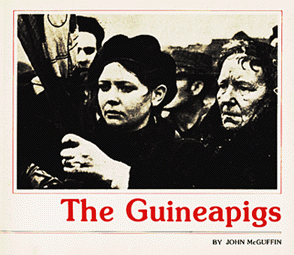
His latter book, "The Guineapigs" was about fourteen Irish political prisoners, with whom the British experimented with sensory deprivation torture in 1971. With the return of political Internment without trial this form of torture is still continued particularly with Marian Price held for a year in solitary confinement. Their 'techniques' which were outlawed after Britain was convicted at the International Court of Human Rights at Strasbourg. Britain exported the techniques to its neo-colonies and its commonwealth worldwide. His book published in 1974 was sold out on his first run but was taken off the shelf and censored by the British Government as is today's internment.
Modern torture techniques such as 'Sensory Deprivation' is still being perfected by the British on guineapigs like Marian Price and her comrades for future use against civilians. John McGuffin being an ex-internee himself also spent two years researching the book, where he named the torturers. None of the British Army or RUC were ever convicted of torture or brutality, despite the fact that the British were forced to pay out more than $5 million in compensation to victims of torture.
In his earlier book called 'Internment' in Chapter 7 he wrote:
"THE POLITICS OF INTERNMENT 1971
In the mid-1960's people might have been forgiven for thinking that internment was a thing of the past. (True, the obnoxious Special Powers Acts were still on the Statute Book, but they were in abeyance). Such thinking was not to be right, however. The monolithic structure of Unionism proved incapable of reforming itself under the onslaught of the civil rights campaign. Terence O'Neill might have been able to save the Unionists with his pragmatic approach and his appreciation of the need for change, but their diehard 'not an inch'
backwoodsmen would have none of it. And so the week of 12 - 16 August 1969 saw the old familiar pattern: a police force unable, and, in many cases unwilling,[1] to prevent the sectarian attack upon the Falls Road periphery, led in some cases by the B specials. That month was to see house burning, intimidation and murder — ten civilians dead, including a 9-year-old boy asleep in his bed, shot by a high-velocity Browning machine-gun used with murderous recklessness by the police in their Shorland armoured cars; 145 injured, hundreds of families burnt out of their homes, 90% of them Catholic. Free Derry was born that week. The barricades went up in Belfast. The first steps towards the irrevocable demise of Stormont were taken. And, predictably, men were detained, without charge or trial....."
"But the Unionist hierarchy learn nothing from history. The gangling figure of Chichester Clark, the stand-in PM, shambled off into obscurity as 1970 and 1971 saw an escalation of the violence by the Provisional IRA, themselves a reaction to the attempted 'Loyalist' pogrom of 1969.
On 23 March 1971 Brian Arthur Deane Faulkner achieved his lifelong ambition and became PM. The English press warned that he was the 'last man in'. If he couldn't control the situation, direct rule was a certainty. But despite the obvious immensity of the task, Faulkner was confident.
This was the moment for which he had schemed, intrigued and betrayed, for so long. With a staggering record of disloyalty to previous PMs, he could hardly expect to be trusted or liked, but surely all could agree on his shrewdness and ability.
In fact, Faulkner's intelligence was always greatly over-rated by the media. And his biggest mistake was soon to come. The Sunday Times 'Insight' team claim[2] that "when he took over the issue was not whether internment was to come, but when and on what scale. By then Faulkner had been an advocate of internment inside Chichester Clark's Joint Security Committee, for six months." Whether this is true or not, and on balance it seems a reasonable statement, it is certain that Faulkner had completely failed to learn the lesson of how and when internment 'worked'. He had been Minister for Home Affairs in 1959 under Brookeborough, and, with the help of his trusty aide, the civil servant William Stout, he had been responsible for the implementation of internment, which he apparently felt to be responsible for the defeat of the IRA border campaign. As is made clear already, this just was not so......"
Forty years later in 2012 who would have thought, we would have "Internment" again or a 'Peace Process' without Due Process ! The withdrawal of the SDLP from Stormont was the response of the only Nationalist opposition last time the other sadistic fox hunter Brian Faulkner introduced internment and they established an "Alternative Assembly" in Strabane. Oppostion is still not tolerated within Stormont or without, these days by the unelected Englishman in Ireland Paterson but yet again the SDLP are the only real voices of clarity and passion there, opposing the internment of Marian Price and the jailing of all genuine opponents of British Occupation in Ireland.
Peace and democracy are still the few Brit buzz words not censored but a cursory examination shows that at best they are a satire. Indeed Her Majesty's unelected Paterson with his army of secret service puppet masters at Hollywood, along with his fellow English RUC man Baggot, will not tolerate any Irish opposition to their Irish occupation. Indeed he also employs certain Provo leaders who are well greased, as storm troopers and censors with their bastardized Voltaire version of a dishonourable peace.
In 1971 Faulkner offered in Stormont to the SDLP a degree of power-sharing. The SDLP have clearly said they were obliged in principle to leave Stormont because Foxhunter Faulkner introduced internment without trial as has his despotic horsey successor. The SDLP curiously are the only party to challenge MI5's along with Paterson and Baggot's absolute control of Stormont who to derive their authority from Her Majesty not mere commoners. However the two Englishmen have presided over the disappearance of Her Majesty's documentation in the instance of Marian Price which is further perverting the course of justice or more appropriately injustice, on the matter. This constitutes criminality carrying a life sentence for non nobility such as commoners. Further, be it Queen's English or plain English they both should be charged with kidnap be they citizens, commoners or the protected species of horsey Tory blood hunters in Occupied Ireland.
Related Link: http://twitpic.com/photos/BrianClarkeNUJ
Labels:
Due Process,
Internment,
Ireland,
IRISH,
John McGuffin,
Malvinas,
Peace process,
The Guineapigs
Friday, February 17, 2012
The Guineapigs is the title of a book by John McGuffin, where... on Twitpic
Labels:
Blogger,
British Torture,
Internment,
John McGuffin,
Marian Price,
The Guineapigs,
twitpic
Friday, December 17, 2010
GENERAL FUCKWITTAGE
"Serious fuckwittage" Bridget said loudly.
"Yeah" agreed Shaz, "that guy's buried himself in his own fuckwittage."
A couple of years ago the former director of the FBI Louis Freeh, attacked Britain's MI5 for its "long and painful history" in British Occupied Ireland. He told the Wall Street Journal that the spy agency's operations in Occupied Ireland had been decades of "secrecy and non-transparency" and he argued vehemently against any such agency being established in the States.
MI-5 which is officially known as the Security Service is based in appropriately named Holywood, in British Occupied Ireland, where they are supposed to be the intelligence gathering arm of the British paramilitary police the PSNI but are in fact the de-facto government of Occupied Ireland, with an elected filtered executive in the province, to rubber stamp their polices and create the illusion of a semi-democratic single party state, in what is in reality is Ireland's second British compliant scum statelet.
Mr Freeh openly criticised MI5, which worked with the FBI intimately in operations against the IRA while he was FBI director. The FBI published Freeh's comments in a Press release on its own FBI website. Freeh angrily in the strongest possible terms, rejected arguments by a neo-con federal court judge Posner, that the United States needs its own version of MI5. Mr Freeh described the idea as "dangerous and dumb".
He said "Judge Posner's citation to England's MI5 is romantic enough but needs to be qualified by the long and painful history of its operations in Northern Ireland, which are still unfolding after decades of secrecy and non-transparency." Warning that such an organisation could not in any way be trusted by the US public, he accused Judge Posner of giving a " long winded thesis" that had no bearing in reality.
Freeh argued incorrectly, post 9/11, that the American public opinion would never tolerate a CIA-type organisation working against its own US citizens or non-citizens "who live and work under our flag. I suppose that this secret-police agency would appear before Congress in closed sessions and operate with a black budget,"
Freeh who resigned in 2001 after ten years as FBI director, previously worked very closely with British spying agencies, such as MI-5 and MI-6 and obviously had an intimate knowledge of how British secret services really worked. He had serious confrontations with President Bill Clinton, because of his efforts at prosecuting US-based IRA members. President Clinton and the former FBI chief had fierce, shouting, exchanges over Bill Clinton's refusal, to allow the prosecution of four Miami-based IRA gun-runners.
If a hardliner such as Freeh, had such a poor opinion of MI-5, it begs the question of what kind of a fuckwittage junta, is really running British Occupied Ireland, presently.
READ MORE @ http://www.therebelsyell.com/
LINK - ‘The Guineapigs’ by John McGuffin
REBELLION ! - John Pilger Link
Subscribe to:
Posts (Atom)